Big Red Book
Celebrating television's This Is Your Life





David BELL (1921-1992)
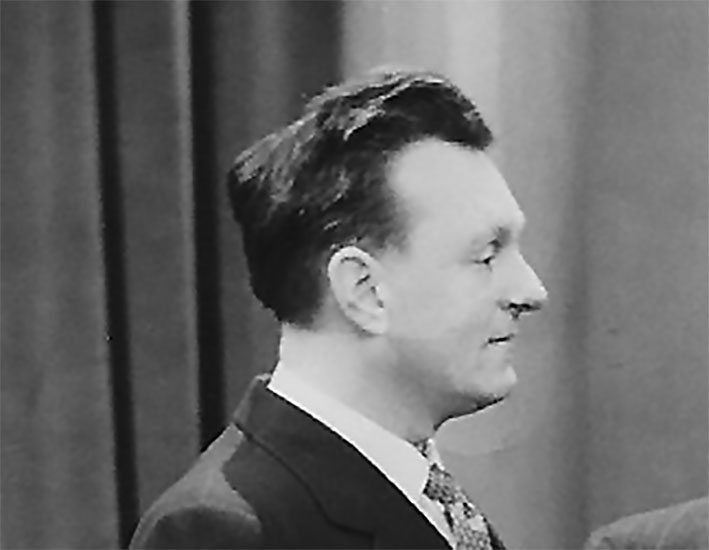
THIS IS YOUR LIFE - David Bell, businessman, campaigner and former soldier, was surprised by Eamonn Andrews after being driven in a car onto the stage of the BBC Television Theatre, having been led to believe he was there to play a small part in a film for St Dunstans.
David, who was born in Edinburgh and educated at Leith Academy, was an apprentice draughtsman before enlisting as a Sapper in the Royal Engineers at the outbreak of the Second World War. In June 1942, stationed in the Western Desert, he was preparing a defensive position for the Battle of Knightsbridge outside Tobruk when a landmine he was helping to clear exploded. David sustained severe facial damage, complete loss of sight and lost both hands.
Despite his disabilities and with the help of St Dunstan's - a charity providing training and rehabilitation to blind veterans - David opened a sweet and tobacconist shop in Edinburgh and later gained academic success at Edinburgh University with a Master of Arts in 1952 and a Bachelor of Commerce in 1955.
programme details...
- Edition No: 48
- Subject No: 48
- Broadcast live: Mon 30 Dec 1957
- Broadcast time: 7.50-8.20pm
- Venue: BBC Television Theatre
- Series: 3
- Edition: 14
on the guest list...
- Lt Douglas Holmes
- Mrs Bell - mother
- Bobbie Constable
- Anne McMillan
- Frederick Ripley
- Robert Skeldon
- Sandy Stewart
- Francoise Rousselet
- Jacqueline Dubosc
- Bill Davidson
- Dick Cain
- Judith Cain
- Bruce Cooper
- Sybil - wife
- David - son
- Diana - daughter Filmed tribute:
- Sir Ian Fraser
production team...
- Researchers: Nigel Ward, Ray Marler, Ronald Vivian
- Writer: Nigel Ward
- Director: unknown
- Producer: T Leslie Jackson
saluting the armed forces
This Is Your Life by Eamonn Andrews
Weekend Magazine reports from behind-the-scenes
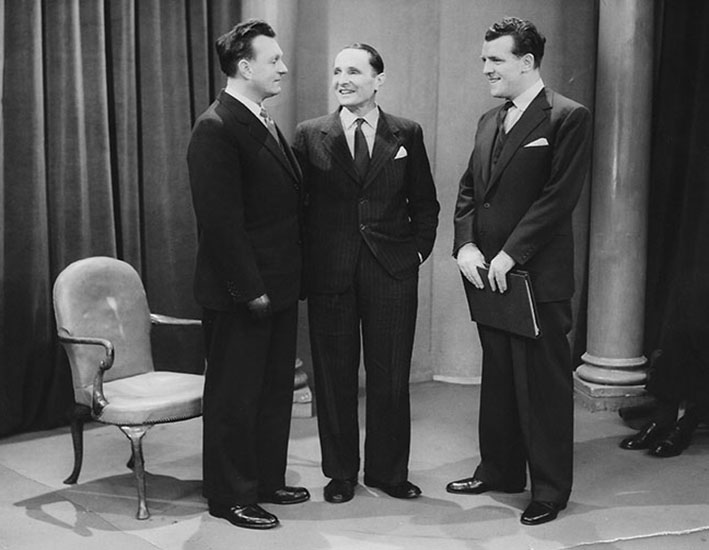
David Bell and guest Frederick Ripley with Eamonn Andrews on This Is Your Life
The Liverpool Echo 31 December 1957
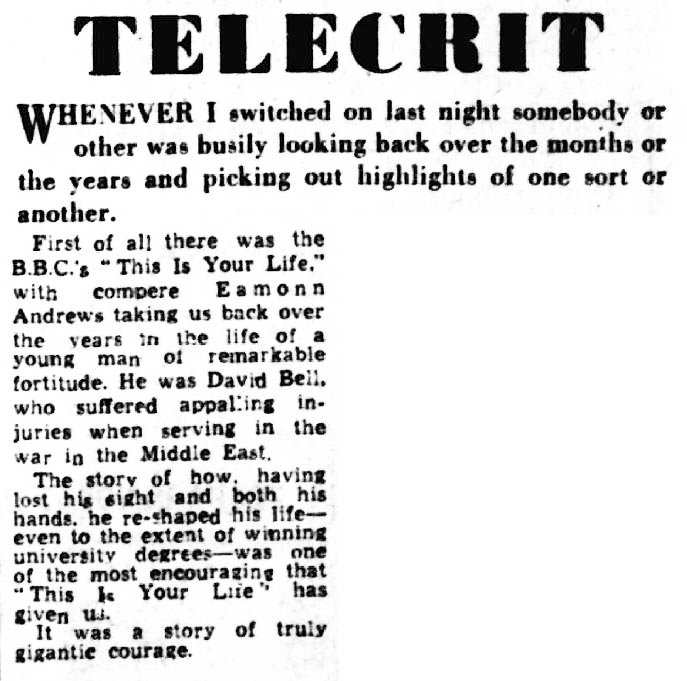
WHENEVER I switched on last night somebody or other was busily looking back over the months or the years and picking out highlights of one sort or another.
First of all there was the BBC's This Is Your Life with compere Eamonn Andrews taking us back over the years in the life of a young man of remarkable fortitude. He was David Bell, who suffered appalling injuries when serving in the war in the Middle East.
The story of how, having lost his sight and both his hands, he re-shaped his life - even to the extent of winning university degrees - was one of the most encouraging that This Is Your Life has given us.
It was a story of truly gigantic courage.
Evening Express 31 December 1957
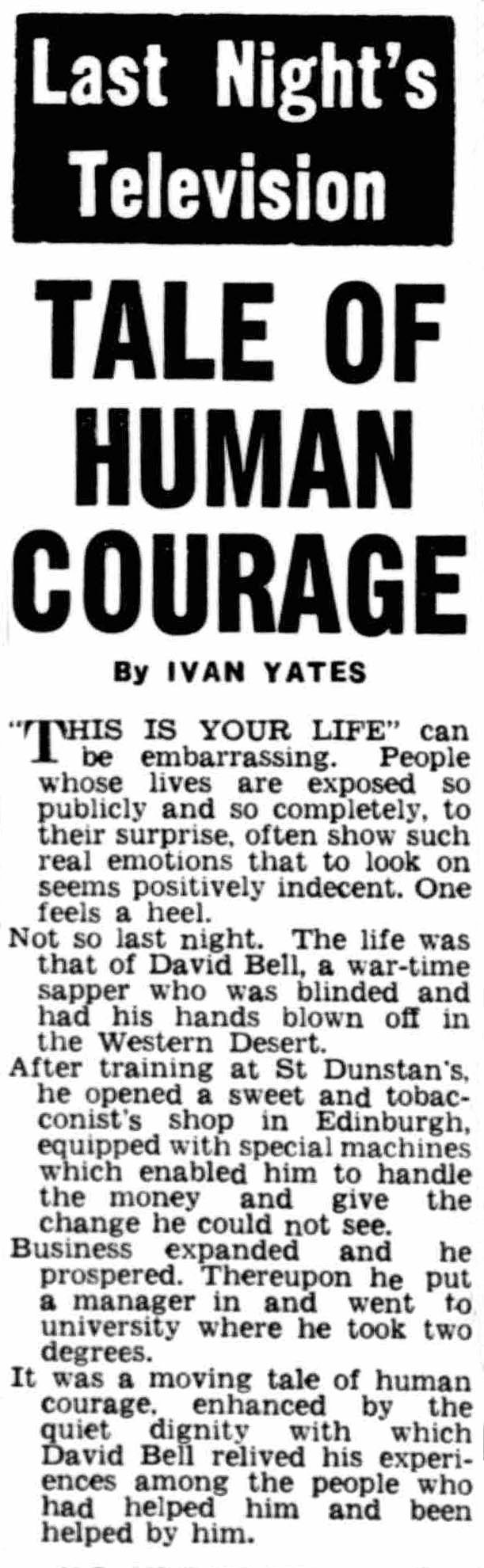
Last Night's Television
By IVAN YATES
THIS IS YOUR LIFE can be embarrassing. People whose lives are exposed so publicly and so completely, to their surprise, often show such real emotions that to look on seems positively indecent. One feels a heel.
Not so last night. The life was that of David Bell, a war-time sapper who was blinded and had his hands blown off in the Western Desert.
After training at St Dunstan's, he opened a sweet and tobacconist's shop in Edinburgh, equipped with special machines which enabled him to handle the money and give the change he could not see.
Business expanded and he prospered. Thereupon he put a manager in and went to university where he took two degrees.
It was a moving tale of human courage, enhanced by the quiet dignity with which David Bell relived his experiences among the people who had helped him and been helped by him.
Edinburgh Evening News 31 December 1957
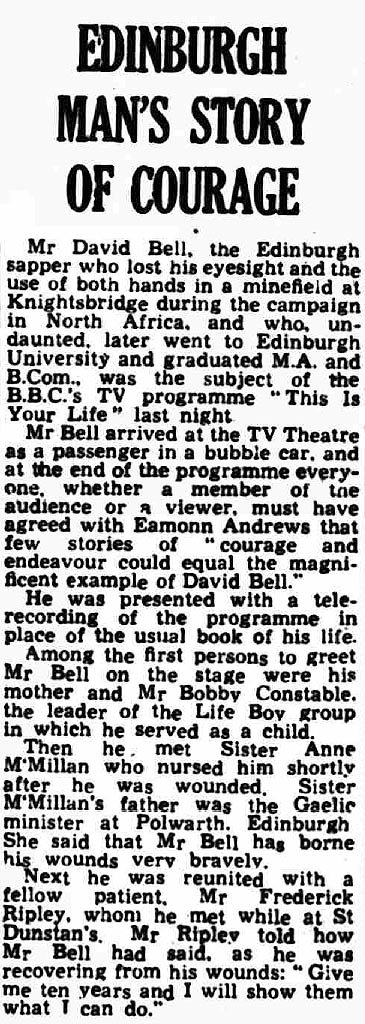
Mr David Bell, the Edinburgh sapper who lost his eyesight and the use of both hands in a minefield at Knightsbridge during the campaign in North Africa, and who, undaunted, later went to Edinburgh University and graduated M.A. and B.Com, was the subject of the BBC's TV programme This Is Your Life last night.
Mr Bell arrived at the TV theatre as a passenger in a bubble car, and at the end of the programme everyone, whether a member of the audience or a viewer, must have agreed with Eamonn Andrews that few stories of "courage and endeavour could equal the magnificent example of David Bell."
He was presented with a tele-recording of the programme in place of the usual book of his life.
Among the first persons to greet Mr Bell on the stage were his mother and Mr Bobby Constable, the leader of the Life Boy group in which he served as a child.
Then he met Sister Anne McMillan who nursed him shortly after he was wounded. Sister McMillan's father was the Gaelic minister at Polwarth, Edinburgh. She said that Mr Bell has borne his wounds very bravely.
Next he was reunited with a fellow patient, Mr Frederick Ripley, whom he met while at St Dunstan's. Mr Ripley told how Mr Bell had said, as he was recovering from his wounds: "Give me ten years and I will show them what I can do."
Daily Herald 31 December 1957
This Is Your Life made some amends with a story more moving than anything in the American film.
Its hero was David Bell, a Scots sapper who was blinded and lost both hands before Alamein.
He gained an M.A. and a Bachelor of Commerce degree at Edinburgh - passing his exams by dictating to a typist.
He built up a prosperous business, helped by his wife and mother of his two children. And he has kept his sense of humour.
That's courage.
The Birmingham Mail 31 December 1957
LAST NIGHT'S VIEWING
SOME backward glances were taken by TV last night - always a fashionable exercise as the year nears its end.
It was done largely in the spirit, commended by the poet, of those who, with danger dared, "look back and smile at perils past."
There was the individual example of this kind of courage in the BBC's This Is Your Life, and there was the response of a whole nation, America, to the leadership of Roosevelt that rescued millions from the great slump of the thirties.
THE young Scottish ex-soldier, David Bell, who after losing his sight and both hands in a grenade explosion near Tobruk founded a retail business and then won distinction in his studies at Edinburgh University, made the 50th This Is Your Life probably the most inspiriting record of business achievement ever probed by the programme.
North Shields Evening News 31 December 1957
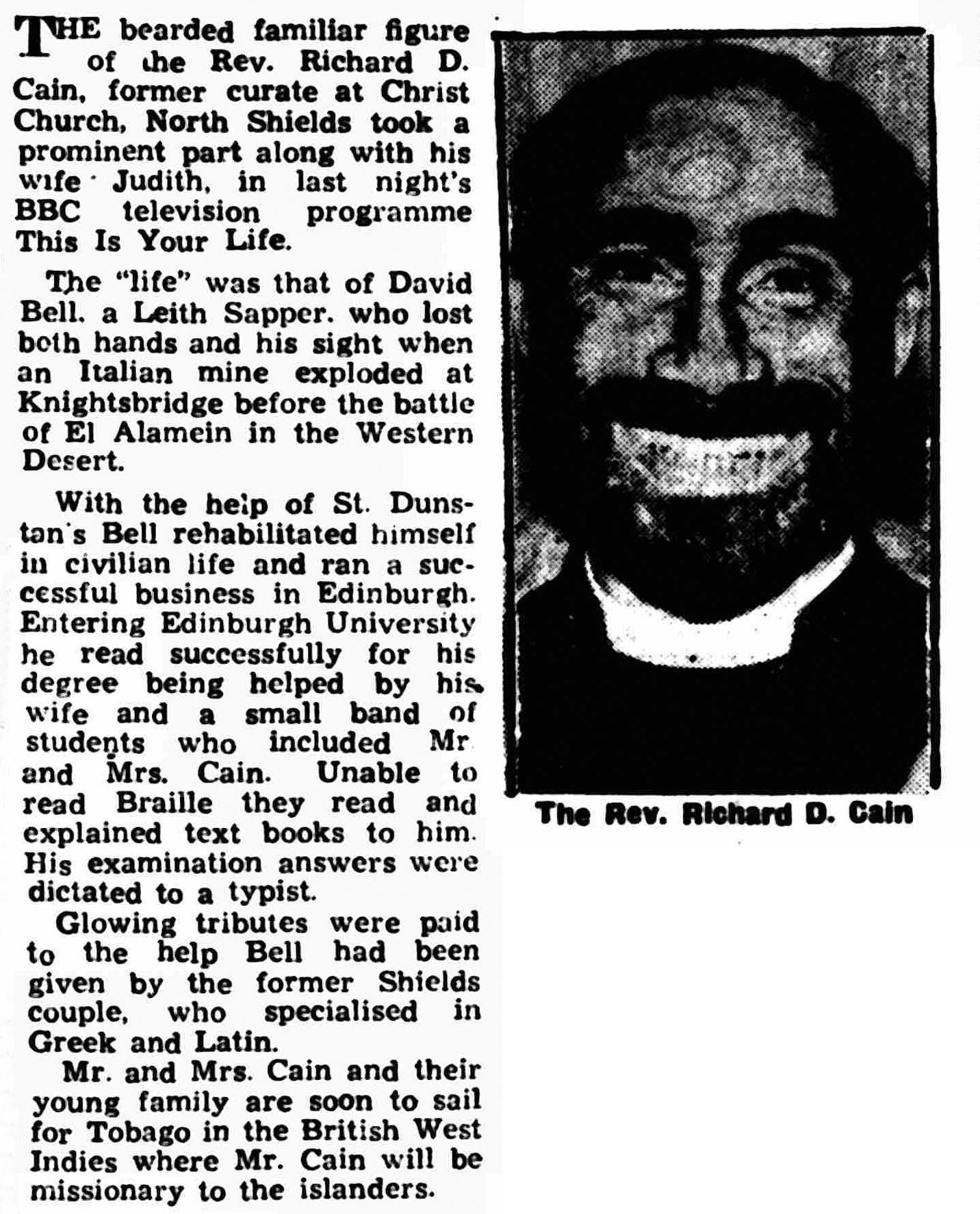
THE bearded familiar figure of the Rev Richard D Cain, former curate at Christ Church, North Shields took a prominent part along with his wife Judith, in last night's BBC television programme This Is Your Life.
The "life" was that of David Bell, a Leith Sapper, who lost both hands and his sight when an Italian mine exploded at Knightsbridge before the battle of El Alamein in the Western Desert.
With the help of St Dunstan's Bell rehabilitated himself in civilian life and ran a successful business in Edinburgh. Entering Edinburgh University he read successfully for his degree being helped by his wife and a small band of students who included Mr and Mrs Cain.
Unable to read Braille they read and explained text books to him. His examination answers were dictated to a typist.
Glowing tributes were paid to the help Bell had been given by the former Shields couple, who specialised in Greek and Latin.
Mr and Mrs Cain and their young family are soon to sail for Tobago in the British West Indies where Mr Cain will be missionary to the islanders.
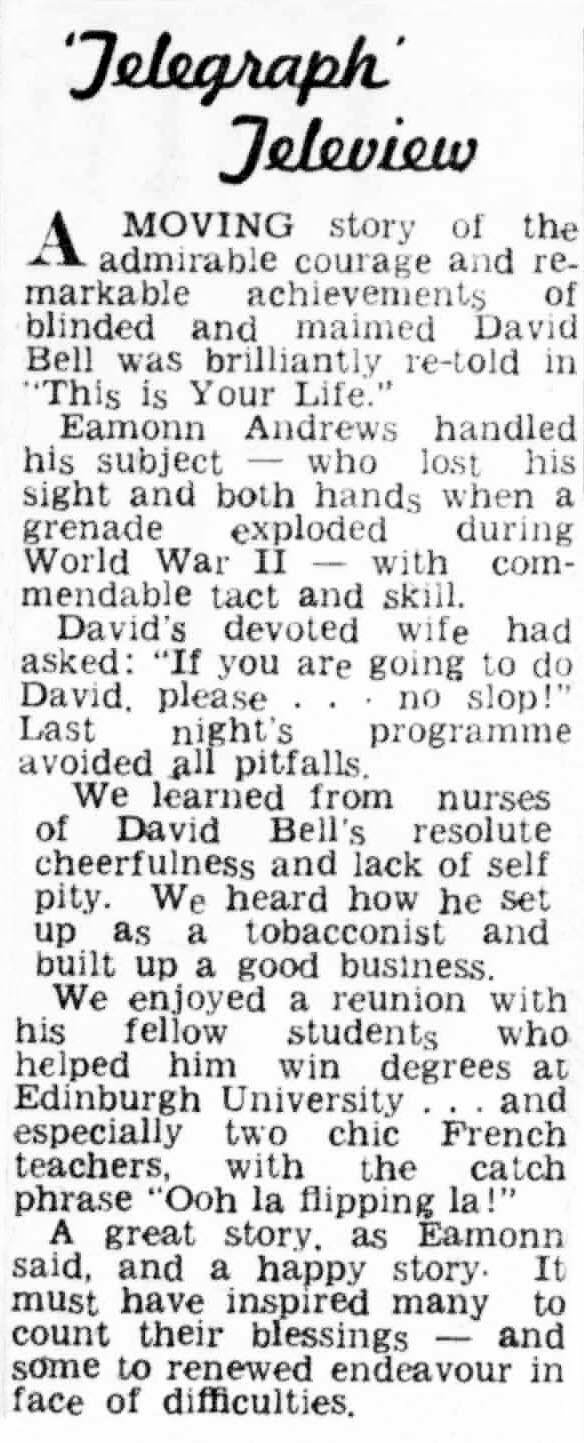
Evening Telegraph 31 December 1957
A MOVING story of the admirable courage and remarkable achievements of blinded and maimed David Bell was brilliantly re-told in This Is Your Life.
Eamonn Andrews handled his subject - who lost his sight and both hands when a grenade exploded during World War II - with commendable tact and skill.
David's devoted wife had asked: "If you are going to do David, please... no slop!" Last night's programme avoided all pitfalls.
We learned from nurses of David Bell's resolute cheerfulness and lack of self pity. We heard how he set up as a tobacconist and built up a good business.
We enjoyed a reunion with his fellow students who helped him win degrees at Edinburgh University... and especially two chic French teachers, with the catchphrase "Ooh la flipping la!"
A great story, as Eamonn said, and a happy story. It must have inspired many to count their blessings - and some to renewed endeavour in face of difficulties.
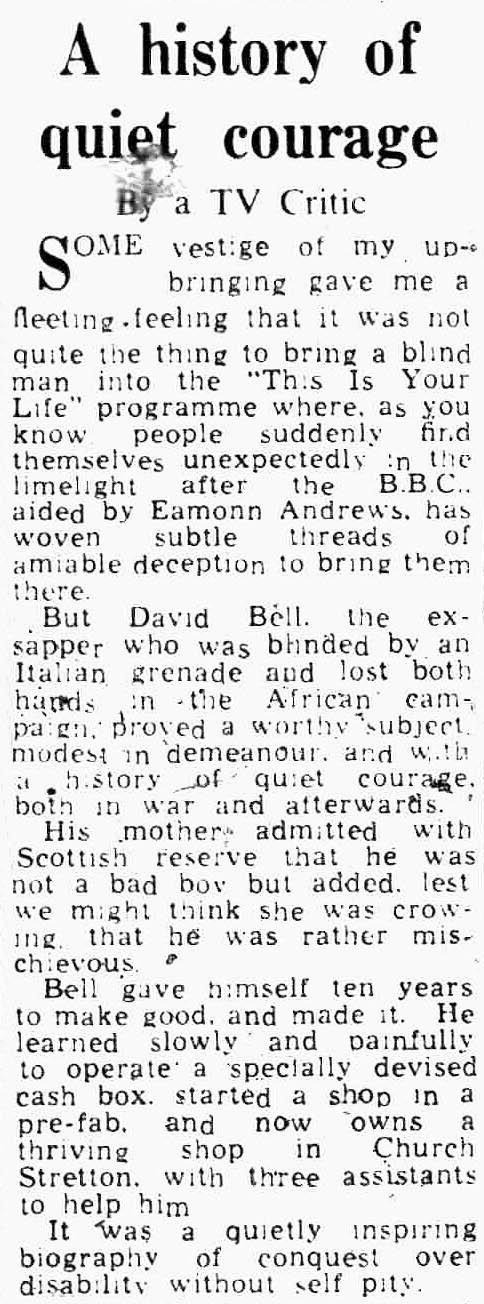
Liverpool Daily Post 31 December 1957
By a TV Critic
SOME vestige of my upbringing gave me a fleeting feeling that it was not quite the thing to bring a blind man into the This Is Your Life programme where, as you know people suddenly find themselves unexpectedly in the limelight after the BBC aided by Eamonn Andrews, has woven subtle threads of amiable deception to bring them there.
But David Bell, the ex-sapper who was blinded by an Italian grenade and lost both hands in the African campaign proved a worthy subject modest in demeanour and with a history of quiet courage, both in war and afterwards.
His mother admitted with Scottish reserve that he was not a bad boy but added, lest we might think she was crowing, that he was rather mischievous.
Bell gave himself ten years to make good, and made it. He learned slowly and painfully to operate a specially devised cash box, started a shop in a pre-fab, and now owns a thriving shop in Church Stretton, with three assistants to help him.
It was a quietly inspiring biography of conquest over disability without self pity.
St Dunstan's Review January 1958
David Bell, MA (Edin), has been invited to serve on the Appeals Committee of the BBC Advisory Council (Scotland). The appointment takes effect from January 1st, 1958, for three years.
As many St Dunstaners will know, David was the subject of the BBC's television feature, This Is Your Life, on Monday, December 30th.
This programme always arouses a certain amount of controversy upon the question of good taste (the subject does not know that he is to appear on television, but is brought to the studio on some other pretext). The newspaper critics, however, were unanimous in praising David's bearing throughout it all. "Gay, serene and friendly," was how one writer put it.
The Independent 6 March 1992
BYLINE: By DEMETER LOWRISON
David Bell, businessman and campaigner for the disabled, born Edinburgh 6 February 1921, married 1945 Sybil Page (one son, one daughter), died Haywards Heath Sussex 2 March 1992.
DAVID BELL was a charity worker, a disabled businessman and a worker for European reconciliation.
Born in Edinburgh in 1921, Bell was educated at Leith Academy and Edinburgh University, and was an apprentice draughtsman with the Edinburgh bus company SMT before the Second World War. He planned to study medicine and was a volunteer with St John's Ambulance (now St John Ambulance) when he was mobilised in August 1939 into the Royal Engineers and served in the Egyptian and Libyan campaigns.
In June 1942, while clearing mines before the Battle of Knightsbridge outside Tobruk, Bell sustained severe facial damage, complete loss of sight and lost both hands. Because of his St John's Ambulance training he was able to tell his rescuers what to do about his injuries and also how to take him back through the minefield. When he heard one of the assistants saying, "We'll never get this bastard back alive," he rallied and told him not to be so daft and to get on with it. He was evacuated to South Africa and did not regain consciousness until August. South African surgeons rebuilt an opposable thumb on the left hand and undertook plastic surgery on his face.
He returned to Britain in 1943, to the St Dunstan's rehabilitation unit at Church Stretton in Shropshire. There he met his wife Sybil. He was married in 1945 and returned to Edinburgh to start a small retail tobacco and confectionery business. He was able to run this with the aid of special equipment from St Dunstan's which he operated with his rebuilt left hand with astonishing speed and precision, handing out goods and change. King Farouk of Egypt, hearing of his story, sent a gift of 25,000 monogrammed Egyptian cigarettes to start the business.
The business expanded and moved to new premises. Bell joined the Edinburgh Merchant Company, the Edinburgh Chamber of Commerce and, in 1950, started a degree at Edinburgh University. He graduated with an MA in 1952 and a B Comm in 1955. He continued to take an interest in the university as president of the Undergraduates Association and the Commerce Graduates Association (1965-67), and he sat on the business committee of Edinburgh University's council from 1980 to 1983.
During this time he also worked on behalf of the disabled and for this reason he was the subject of Eamonn Andrews' This Is Your Life programme in December 1957. He was a member of the Round Table and president of the 41 Club (1968); a member of the Disabled Advisory Committee; represented the disabled in local and regional hospital boards; an area representative of The British Limbless (BLESMA); Chair of St Dunstan's Double Handicap Committee; and worked for the National Federation of the Blind. He was in demand as a humorous and fluent speaker at meetings about the disabled (and about business and economics), organised fund-raisings and was a counsellor for the disabled. In 1972 he was appointed MBE.
Bell spoke French and German and through international contacts made while working with societies and for the disabled and ex-servicemen tried to promote post-war understanding. He continued to work and attend meetings despite failing health and in the mid-Eighties moved to Haywards Heath in Sussex.
David Bell was gregarious, a connoisseur of French wines, a bon viveur, with diverse interest in music (he played trombone), fishing, disabled sports and talking books.
The Times 11 March 1992
David Bell, MBE, who was able to use his own experience of severe wartime injuries to benefit the disabled, died on March 2 aged 71. He was born in Edinburgh on February 6, 1921.
DAVID Bell practised courage and persistence in the face of misfortune which left him doubly disabled both blind and handless. His father was "an old contemptible" and had been taken prisoner in the Battle of the Somme. David Bell was educated at Leith Academy and before the war was an apprentice draughtsman although he was a St Andrew's ambulance volunteer and after the war intended to study medicine. After Munich, he tried to join 603 Squadron RAF but being in a reserve profession was rejected. He then wangled his way into the Royal Engineers and was in the First Field Squadron Royal Engineers from Tobruk to Benghazi. At the Battle of Knightsbridge he was clearing mines in outer defences to let guards and tanks out when a mine blew up in his face. He lost his sight, part of one arm from above the elbow, the other from above the wrist and was unconscious for two months.
Evacuated to South Africa he recovered and surgeons rebuilt his limbs to give him a residual grip in his left arm. But he had no sense of touch. General Smuts who visited the hospital was so impressed by David Bell's spirit that he presented him with his own Victory Pin.
Bell returned to England in 1943, to the St Dunstan's rehabilitation centre where he was taught how to type and took up the trombone. He intended to study languages and become an interpreter but his marriage to Miss Sybil Page, who was a volunteer with St Dunstan's, changed that plan and he decided to go into business. He returned to Edinburgh in 1946 to start a small shop. In this he was aided by St Dunstan's and King Farouk of Egypt. King Farouk had read Bell's story in a British newspaper and sent a gift of 25,000 monogrammed Egyptian cigarettes to help start the business. Bell was able to run the small tobacco and confectionery shop with the aid of special equipment from St Dunstan's allowing him to take money and give change. He manipulated this with startling speed and precision.
The business prospered and expanded but he decided to resume his education by going to Edinburgh University. Being handless he was unable to use braille but was helped by many student friends who read to him and composed lecture notes with him. He graduated with an MA in 1952 and a B.Comm in 1955. He continued to take an interest in the university as president of the undergraduates' association and the commerce graduates' association (1965-67) and he sat on the business committee of Edinburgh University's council from 1980-1983. He continued to work on behalf of the disabled during this time and was nominated to local and regional hospital boards. He was vice-president of the National Federation of the Blind and on the Scottish appeals board of the BBC. In December 1957 he was the subject of Eamonn Andrews' This Is Your Life.
He continued to campaign and work for the disabled and was active in the Round Table, setting up the Ex-Tablers Club (41 Club) in Edinburgh. His linguistic skills were much in evidence in international fund-raising and campaigning. He was the 41 Club's president from 1969-70 and lectured in French and German to ex-servicemen's organisations and business groups. He campaigned actively for European reconciliation and in 1972 was appointed MBE for his work for the disabled.
In the 1970s he continued to campaign but suffered increasingly poor health and for this reason moved in the mid-1980s to Haywards Heath to be near the St Dunstan's Blind Ex-Servicemen's Association. He was gregarious but was also a man who could not stand to hear his "nothings monstered." A bon viveur, he was an inspiration to many sighted as well as disabled people. He leaves a wife and two children.
St Dunstan's Review April 1992
'I knew what had happened to me. I had no illusions about that. Major Townsend said: "Well, David, I am sorry to tell you that to save your life we have to remove your eyes so I am afraid you will never see again".'
These are the first words on the soundtrack of St Dunstan's film Partnership for Life. They were spoken by David Bell who died on March 2nd. Left unsaid was the fact that David also suffered the loss of both hands when a booby trap exploded as he was clearing mines in Libya in 1942. Later in the film David talked about and demonstrated some of the devices that enabled him to work and study, but it was an indomitable spirit which really achieved an outstanding career for this distinguished St Dunstaner.
David was born in Edinburgh in 1921 and was working as a draughtsman in 1938 awaiting University Entrance to embark on a medical career. War was looming and he volunteered for 603 Squadron, Royal Air Force, only to be turned down because he was in a reserved occupation. Instead, 'under false pretences' as he put it, he joined the Territorial Army. He served as a sapper in the 1st Field Squadron (Armoured Division), Royal Engineers and fought in the North African campaign with the 7th Armoured Division, the Desert Rats. He was wounded during the Battle of Knightsbridge, outside Tobruk.
He joined St Dunstan's in Tembani and eventually reached Church Stretton where, in the Orange Tree Café, he met Sybil who became his wife and supporter in all he achieved. They were married in 1945. After training, David became St Dunstan's first handless shopkeeper using equipment devised by our Research Department to handle change and dispense cigarettes.
The shop thrived and expanded. With staff to serve and handle stock, David supervised and managed the business. He sought new challenges and became another first – the first blind and handless student at Edinburgh University. With the help of his fellow students, who let him use their notes, and Sybil, who read for him, he studied English, economics, moral philosophy, psychology and social anthropology and was made Master of Arts in July 1952. He immediately embarked on a course for the degree of Bachelor of Commerce, studying accountancy, business methods, French, German and law. He received his degree in 1955.
David served the community in many ways. He was a Member of the Merchant Company of Edinburgh, a member of the Scottish Board of the BBC; the disabled representative on the Local and Regional Hospital Board; he served BLESMA as their representative on the Scottish Council of Social Service and was a member of the Ministry of Labour Disablement Advisory Committee. He also served as Vice-President of the National Federation of the Blind.
Attracted by the charitable schemes it operates, David joined Edinburgh Round Table in 1957 and worked hard as a rank and file member as well as becoming Area Councillor and Edinburgh's delegate to Conferences of the Round Table of Great Britain and Ireland. Tablers retire at 40 and when that time came David became Founder Chairman of Edinburgh Forty-One Club for ex-Tablers.
Once again he rose to high office. A natural linguist who spoke French, German and Russian, David attended international conferences in Europe, United States and Canada. In 1969 he became President of the Association of Ex-Tablers Clubs.
It was for his work for the community in so many fields that he was made a Member of the British Empire in the Birthday Honours in 1972. He had already received an accolade of another sort when, in 1957, he appeared on television's This Is Your Life.
Within St Dunstan's David was a leading light in the group of blind and handless St Dunstaners who will miss him sadly. His energy and initiative led to the exchange of visits with the blind and handless members of the German war-blinded organisation, Bund der Kriegsblinden Deutschland.
In association with Mrs Mary Marsden, David was instrumental in the ceremonial return of St Dunstaners to Church Stretton in 1987. He and Harry Preedy unveiled a plaque in the Parish Church which commemorated the kindness and friendship extended to St Dunstaners by the people of the town during the Second World War.
David won Sybil's love in the face of much competition in Church Stretton and he deeply appreciated all she did for him. Although he had never seen her, he told how people had described her to him as being a little like Judy Garland. He had original wit and spoke eloquently on special occasions. His humour could be self-deprecating as when he described arriving at Church Stretton, facing a new course and saying to himself: 'Because of my disability what can I do? Talk is the best thing – my tongue isn't disabled!'
Those who knew him will know that St Dunstan's has lost one of its outstanding characters but the loss for Sybil and her son and daughter, David and Diana, is immeasurably greater. We offer our sympathy to them and to their families.
A personal tribute by Bill Griffiths
On my release from a Japanese PoW camp in Java, Indonesia, August 1945, I received a telegram from a Mr David Bell saying that although he was totally blind and handless he was enjoying a full and happy life and described his various activities.
That message gave me a very special kind of encouragement and hope which I have always appreciated.
I have come to know and understand David over the past 46 years. He had a quick and lively mind, was forthright and frank, always eager to help and was compassionate towards colleagues with difficulties, and possessed a warm sense of humour with a sharp wit that brought lots of laughter.
I shall be eternally grateful to David for his friendship. All the handless, and many other St Dunstaners, of course, will sorely miss David, and in saying goodbye to him, my heart and gratitude goes out to his loving and charming wife, Sybil.
I was very sorry to learn of the death of Mr David Bell. He was a man of enormous character and determination who overcame the most appalling physical handicaps to follow a career which must certainly have been the envy of most of those who knew him.
Not only does he deserve our heartfelt admiration, but the success which he achieved must also be a tribute to the work of St Dunstan's where he received the first vital treatment and training which built up, both physically and psychologically, a maimed and blinded soldier to take his place in the community and in which he became one of its leading and most respected members.
It is a life story which is an inspiration to us all.
Series 3 subjects
Albert Whelan | Colin Hodgkinson | Vera Lynn | Arthur Christiansen | John Logie Baird | Richard Carr-Gomm | Jack TrainEdith Powell | Anne Brusselmans | Norman Wisdom | Victor Silvester | Jack Petersen | Lucy Jane Dobson
David Bell | Matt Busby | Minnie Barnard | Gordon Steele | Louie Ramsay | Tubby Clayton | Daniel Angel
Anna Neagle | 'Dapper' Channon | Frederick Stone | Paul Field | Noel Purcell | Barbara Cartland
Harry Secombe | Archie Rowe | Humphrey Lyttelton | Francis Cammaerts | A E Matthews