Big Red Book
Celebrating television's This Is Your Life





Frederick STONE GM, BEM (1898-?)
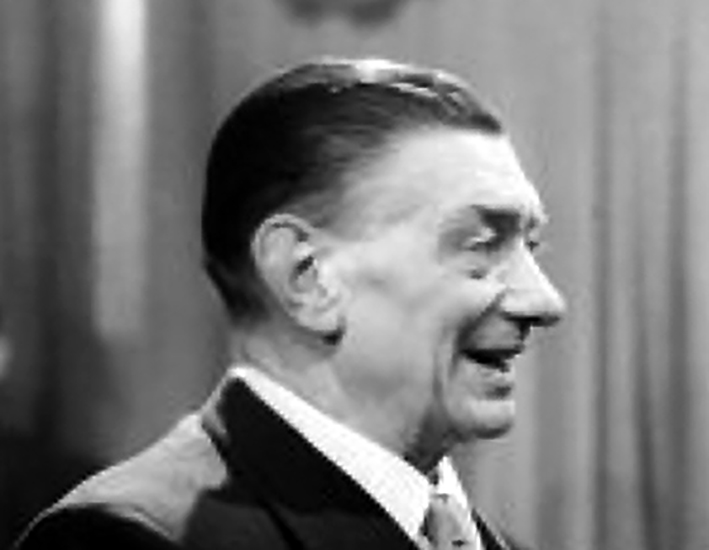
THIS IS YOUR LIFE - Frederick Stone, retired police constable, was surprised by Eamonn Andrews in the audience at the BBC Television Theatre.
Frederick, known affectionately as 'Rodney' or 'Stoney', was born in Gloucester and joined the Metropolitan Police Force in April 1921. He was initially posted to 'A' division and Cannon Row Police Station, Westminster, but left the beat in 1939 to work at the Marlborough Street Police Court.
In his thirty-year career as a constable, he was awarded a King's Police Medal in 1928 for rescuing a man from drowning in the River Thames at night and a British Empire Medal for gallantry in 1941 when, off duty, he helped search a tunnel in a collapsing building to rescue four air raid victims. In 1951 Frederick was invalided out of the Force due to the injuries he suffered while tackling a violent smash-and-grab shop breaker armed with an iron bar - an act for which he was awarded a George Medal for gallantry.
programme details...
- Edition No: 57
- Subject No: 57
- Broadcast live: Mon 3 Mar 1958
- Broadcast time: 8.15-8.45pm
- Venue: BBC Television Theatre
- Series: 3
- Edition: 23
on the guest list...
- Paul Bennett
- Charles Folkes
- Sally - wife
- Harry Evans
- George Tyndall
- Jack Graves
- Sidney - son
- Gilbert - son
- George Lewis
- Edward Blow
- Marty Comprebassi
- Michael Bentine
- Phyllis Holman Richards
- Luigi Ravagnan
- Sabina Cole
- Vivian St George
- Sir John Nott-Bower
related appearance...
- Phyllis Holman Richards - Apr 1963
production team...
- Researcher: George Bruce
- Writer: Nigel Ward
- Director: Vere Lorrimer
- Producer: T Leslie Jackson
- names above in bold indicate subjects of This Is Your Life
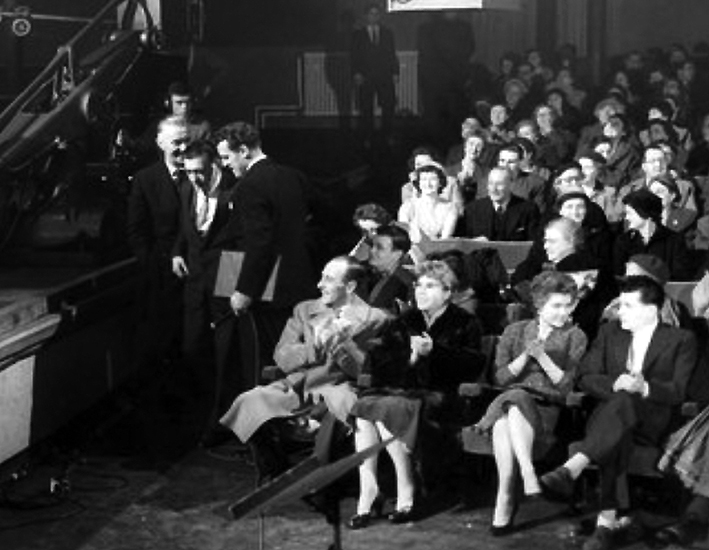
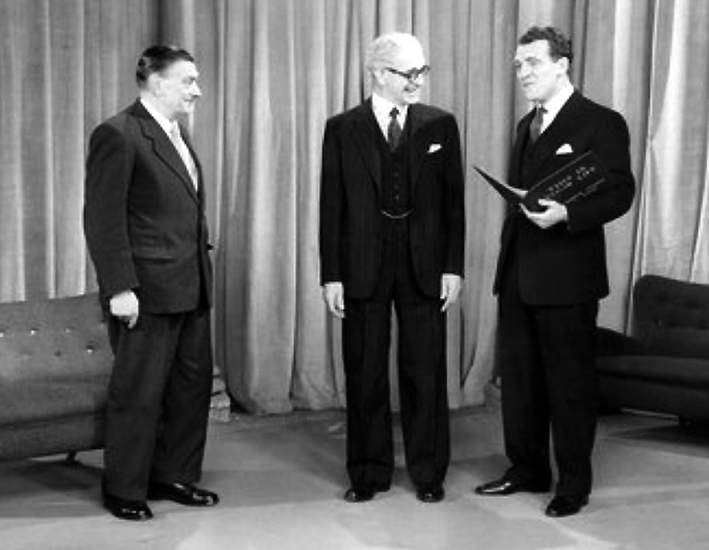
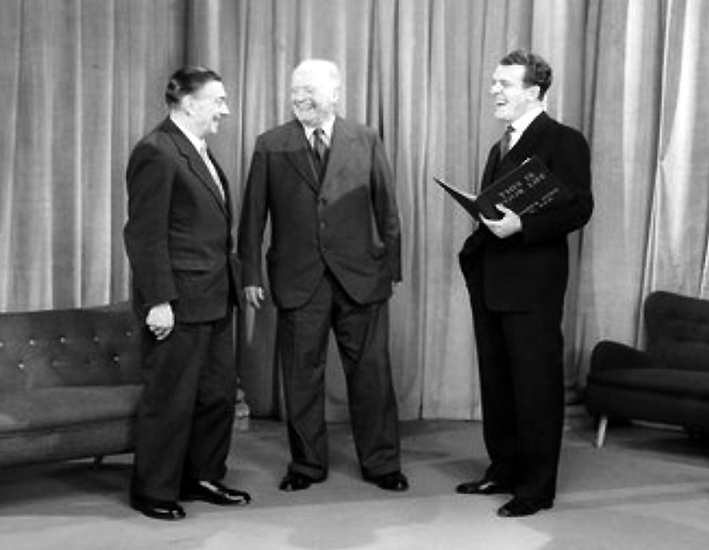
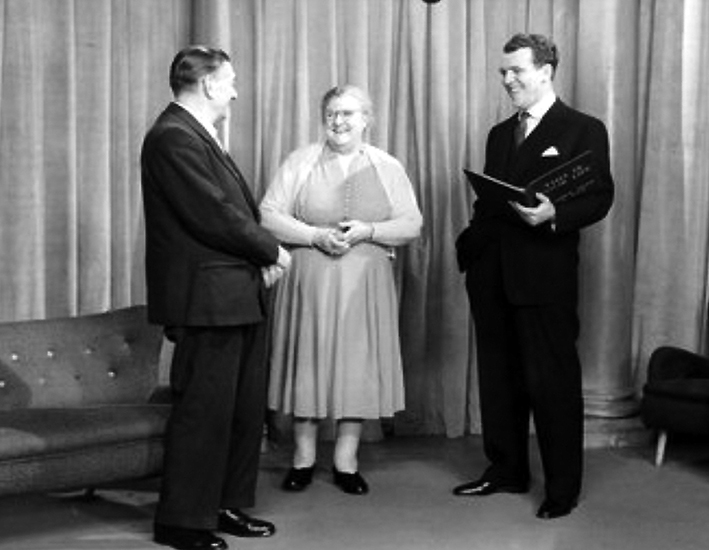
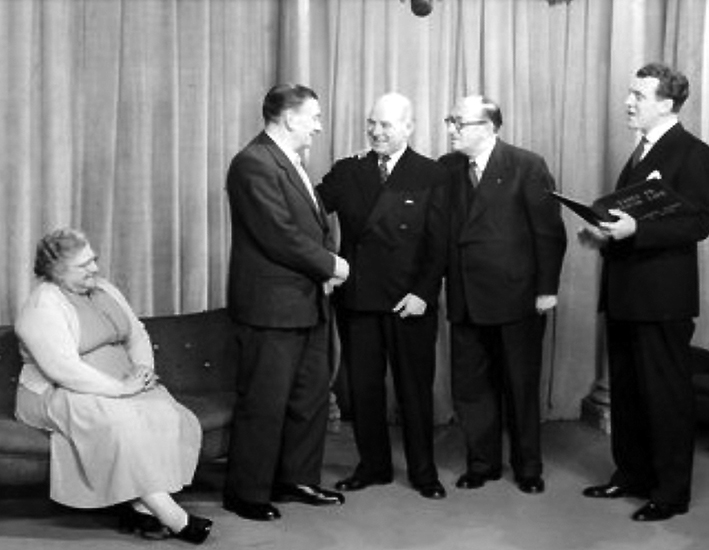
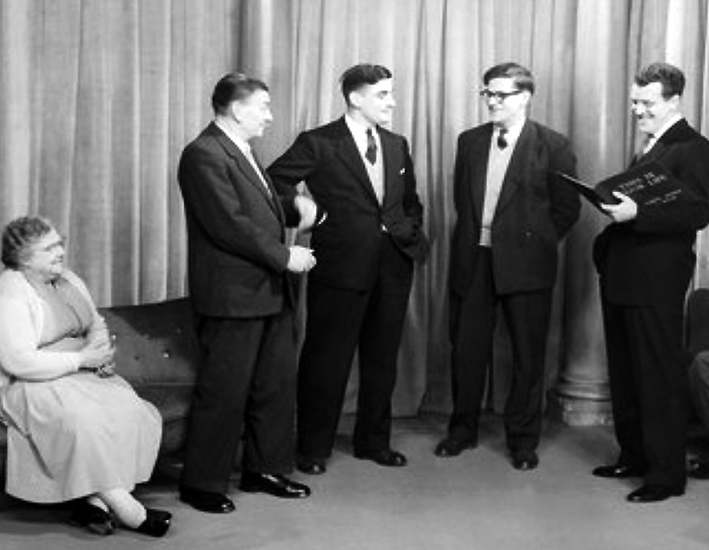
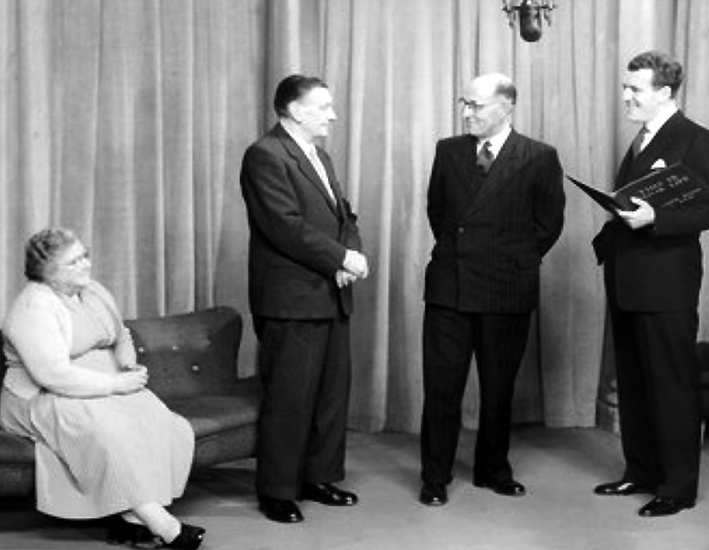
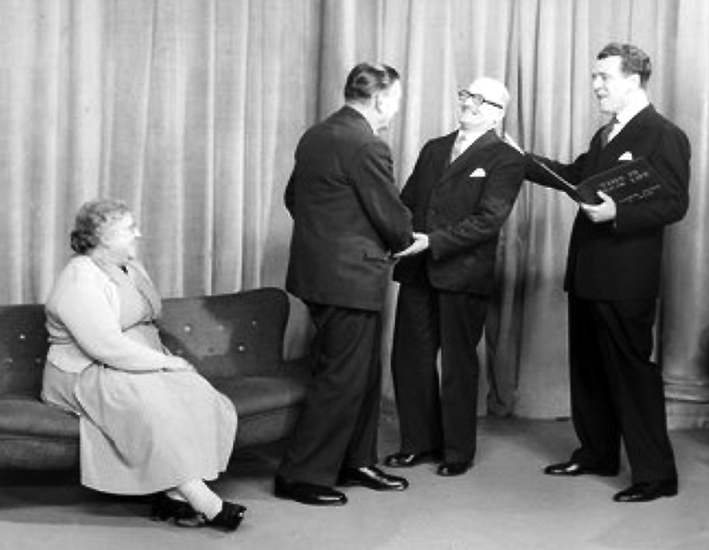
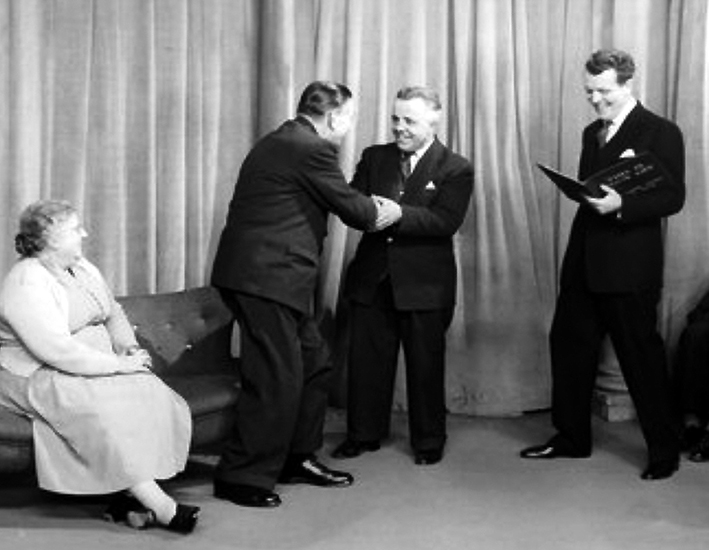
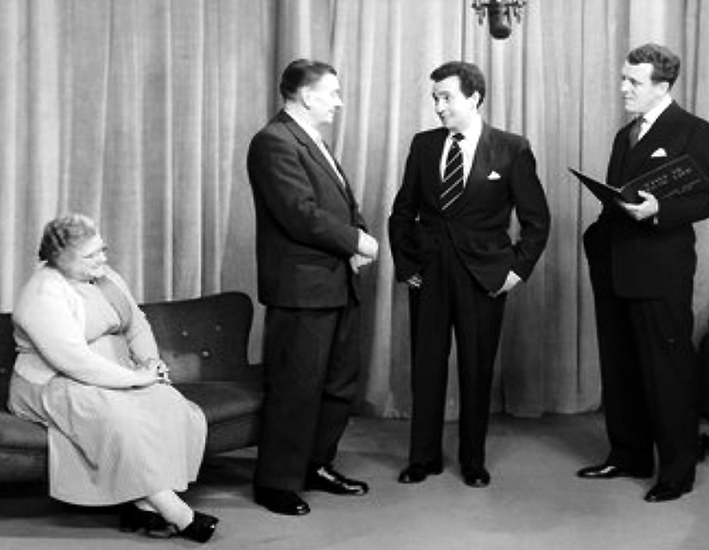
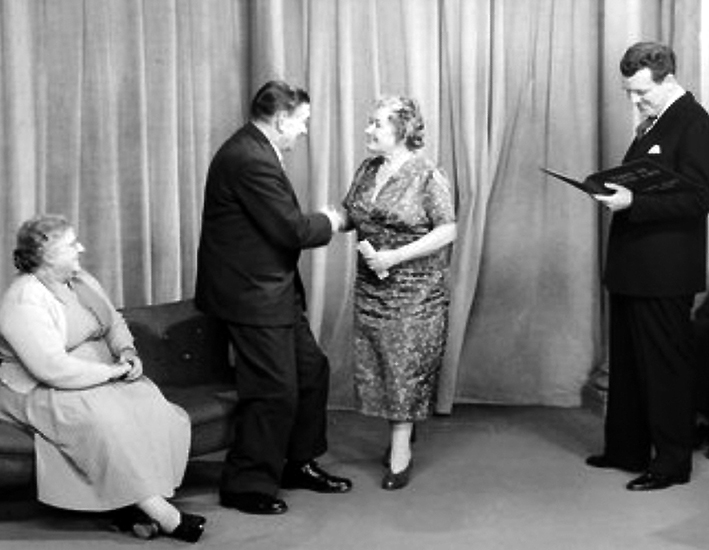
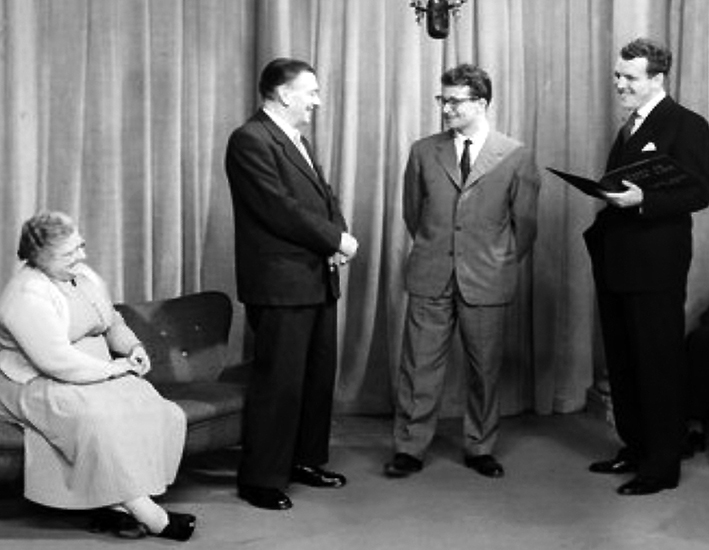
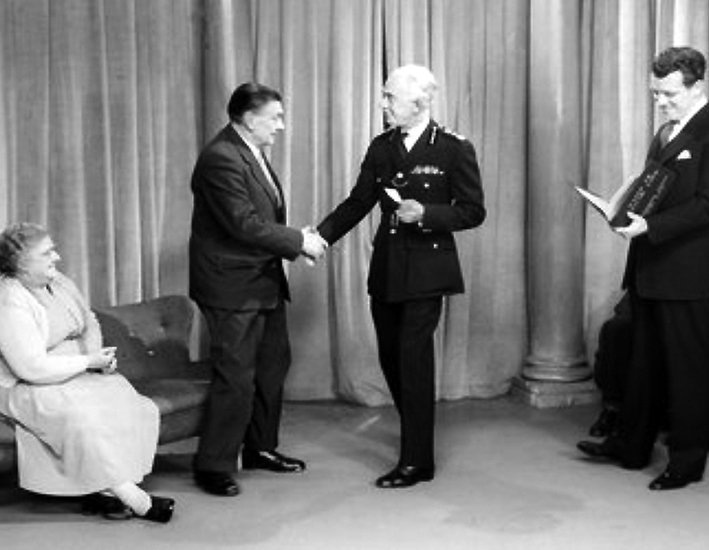
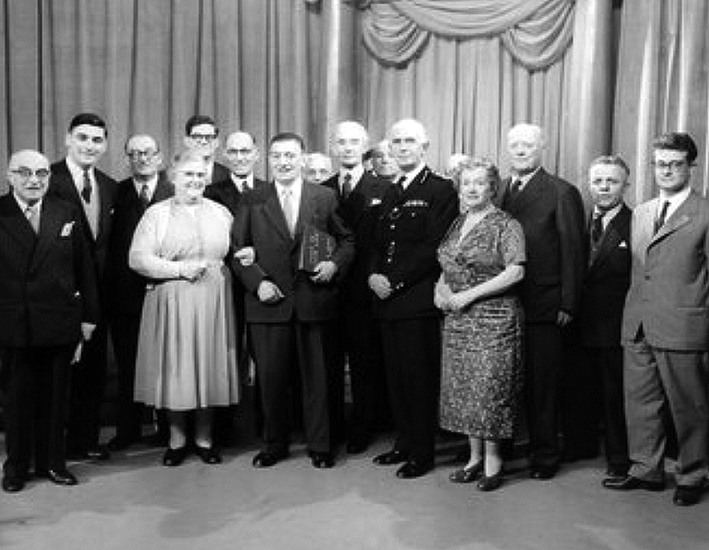
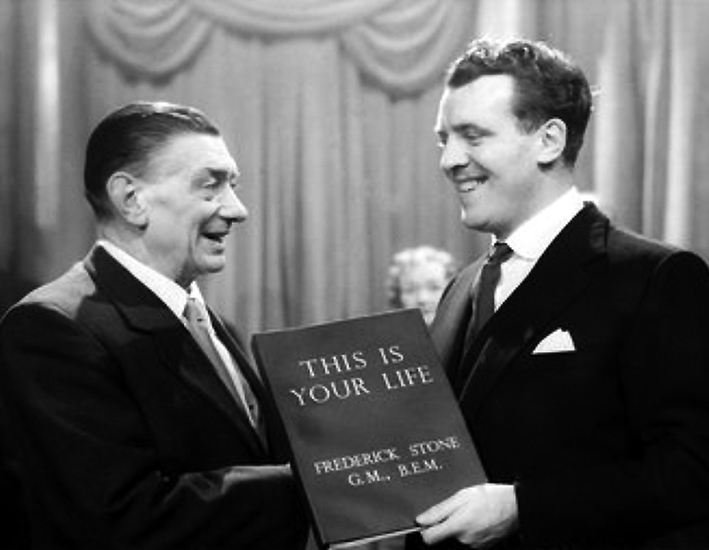
Photographs of Frederick Stone This Is Your Life
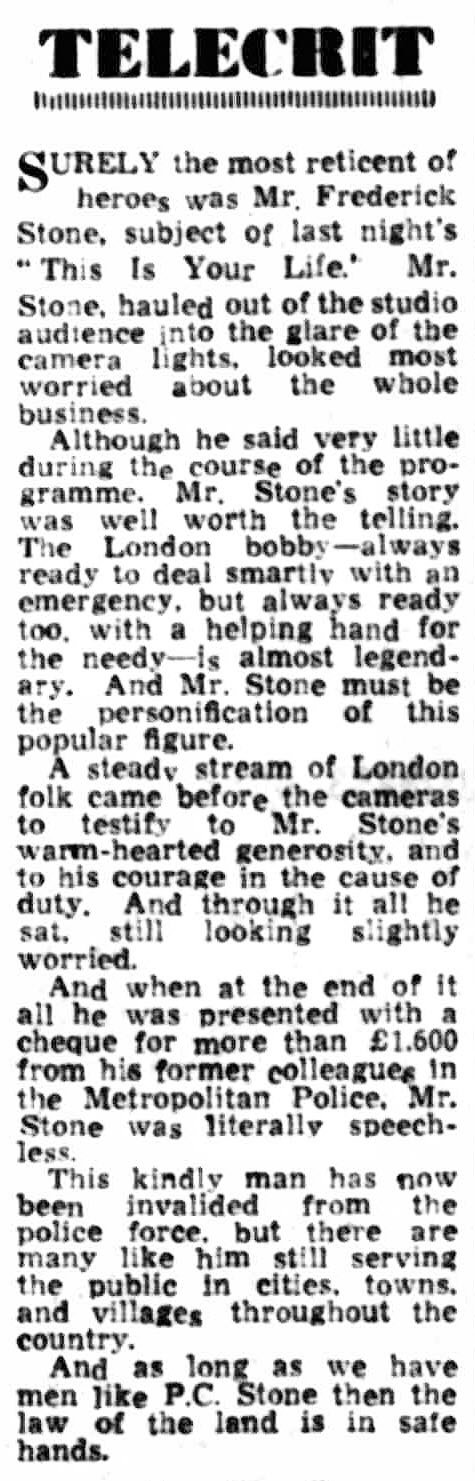
The Liverpool Echo 1 March 1958
SURELY the most reticent of heroes was Mr Frederick Stone, subject of last night's This Is Your Life. Mr Stone, hauled out of the studio audience into the glare of the camera lights, looked most worried about the whole business.
Although he said very little during the course of the programme, Mr Stone's story was well worth the telling. The London bobby - always ready to deal smartly with an emergency, but always ready too, with a helping hand for the needy - is almost legendary. And Mr Stone must be the personification of this popular figure.
A steady stream of London folk came before the cameras to testify to Mr Stone's warm-hearted generosity, and to his courage in the cause of duty. And through it all he sat, still looking slightly worried.
And when at the end of it all he was presented with a cheque for more than £1,600 from his former colleagues in the Metropolitan Police, Mr Stone was literally speechless.
This kindly man has now been invalided from the police force, but there are many like him still serving the public in cities, towns, and villages throughout the country.
And as long as we have men like PC Stone then the law of the land is in safe hands.
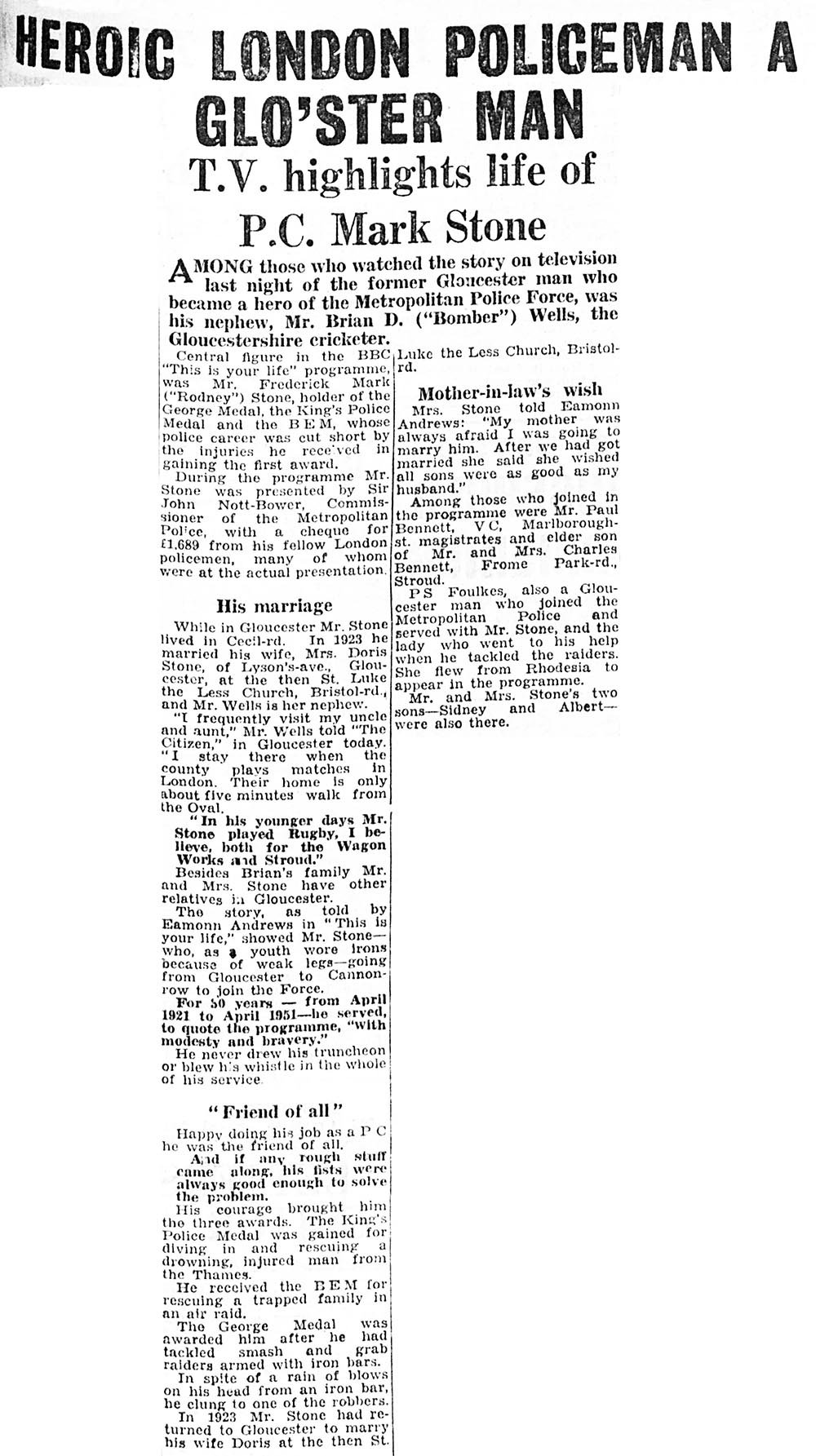
The Citizen 4 March 1958
T.V. highlights life of P.C. Mark Stone
AMONG those who watched the story on television last night of the former Gloucester man who became a hero of the Metropolitan Police Force, was his nephew, Mr Brian D ("Bomber") Wells, the Gloucestershire cricketer.
Central figure in the BBC This Is Your Life programme was Mr Frederick Mark ("Rodney") Stone, holder of the George Medal, the King's Police Medal and the BEM, whose police career was cut short by the injuries he received in gaining the first award.
During the programme Mr Stone was presented by Sir John Nott-Bower, Commissioner of the Metropolitan Police, with a cheque for £1689 from his fellow London policemen, many of whom were at the actual presentation.
His marriage
While in Gloucester Mr Stone lived at Cecil Road. In 1923 he married his wife, Mrs Doris Stone, of Lyson Ave, Gloucester, at the then St Luke the Less Church, Bristol Road, and Mr Wells is her nephew.
"I frequently visit my uncle and aunt," Mr Wells told "The Citizen," in Gloucester today. "I stay there when the county plays matches in London. Their home is only five minutes walk from the Oval."
"In his younger days Mr Stone played Rugby, I believe, both for the Wagon Works and Stroud."
Besides Brian's family Mr and Mrs Stone have other relatives in Gloucester.
The story, as told by Eamonn Andrews in This Is Your Life, showed Mr Stone - who, as a youth wore irons because of weak legs - going from Gloucester to Cannon Row to join the Force.
For 30 years - from April 1921 to April 1951 - he served, to quote the programme, "with modesty and bravery."
He never drew his truncheon or blew his whistle in the whole of his service.
"Friend of all"
Happy doing his job as a PC he was a friend of all.
And if any rough stuff came along, his fists were always good enough to solve the problem.
His courage brought the three awards. The King's Police Medal was gained for diving in and rescuing a drowning, injured man from the Thames.
He received the BEM for rescuing a trapped family in an air raid.
The George Medal was awarded him after he had tackled smash and grab raiders armed with iron bars.
In spite of a rain of blows on his head from an iron bar, he clung to one of the robbers.
In 1923 Mr Stone had returned to Gloucester to marry his wife Doris at the then St Luke the Less Church, Bristol Road.
Mother-in-law's wish
Mrs Stone told Eamonn Andrews: "My mother was always afraid I was going to marry him. After we had got married she said she wished all sons were as good as my husband."
Among those who joined in the programme were Mr Paul Bennett, VC, Marlborough Street magistrates and elder son of Mr and Mrs Charles Bennett, Frome Park Road, Stroud.
PS Foulkes, also a Gloucester man who joined the Metropolitan Police and served with Mr Stone, and the lady who went to his help when he tackled the raiders. She flew from Rhodesia to appear in the programme.
Mr and Mrs Stone's two sons - Sidney and Albert - were also there.
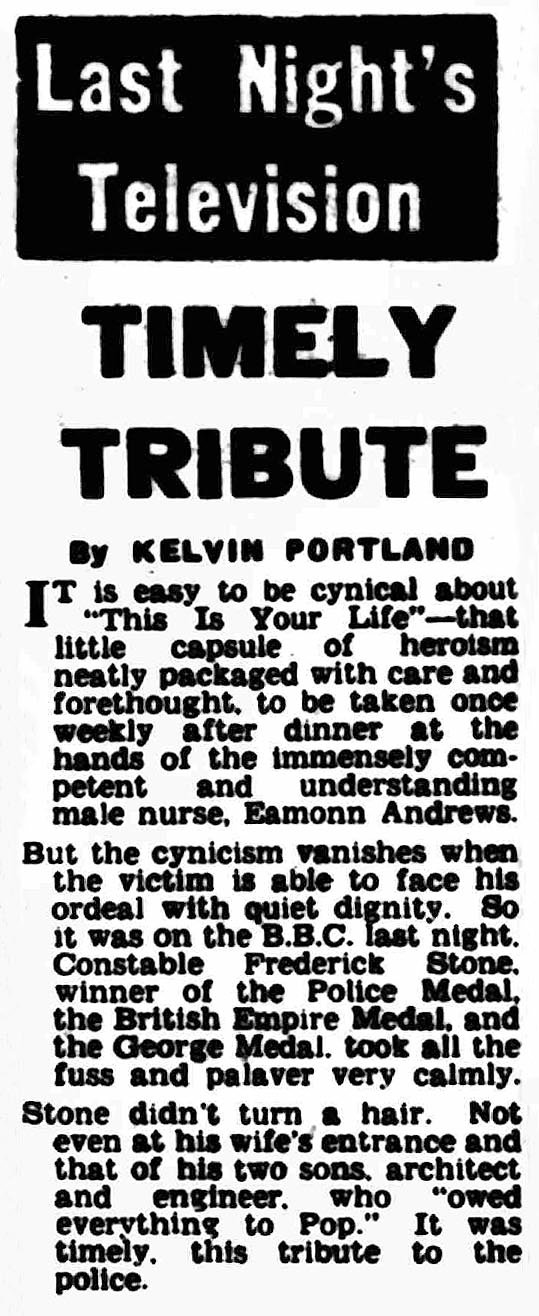
Evening Express 4 March 1958
Last Night's Television
By KELVIN PORTLAND
IT is easy to be cynical about This Is Your Life - that little capsule of heroism neatly packaged with care and forethought, to be taken once weekly after dinner at the hands of the immensely competent and understanding male nurse, Eamonn Andrews.
But the cynicism vanishes when the victim is able to face his ordeal with quiet dignity. So it was on the BBC last night, Constable Frederick Stone, winner of the Police Medal, the British Empire Medal, and the George Medal, took all the fuss and palaver very calmly.
Stone didn't turn a hair. Not even at his wife's entrance and that of his two sons, architect and engineer, who "owed everything to Pop." It was timely, this tribute to the police.
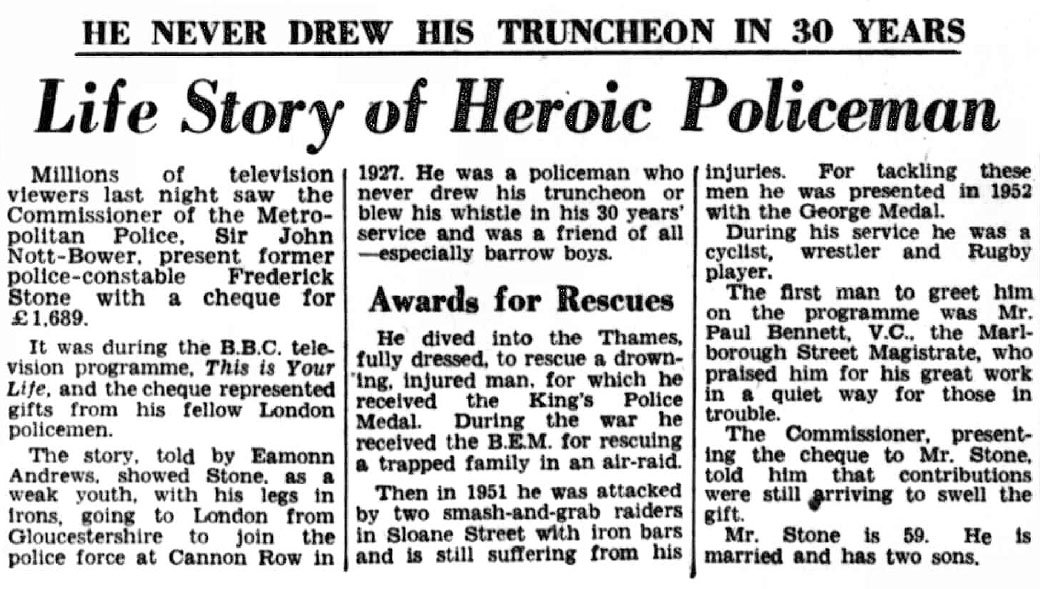
The Birmingham Post 4 March 1958
HE NEVER DREW HIS TRUNCHEON IN 30 YEARS
Millions of television viewers last night saw the Commissioner of the Metropolitan Police, Sir John Nott-Bower, present former police-constable Frederick Stone with a cheque for £1689.
It was during the BBC television programme This Is Your Life, and the cheque represented gifts from his fellow London policemen.
The story, told by Eamonn Andrews, showed Stone, as a weak youth, with his legs in irons, going to London from Gloucestershire to join the police force at Cannon Row in 1927. He was a policeman who never drew his truncheon or blew his whistle in his 30 years' service and was a friend of all - especially barrow boys.
Awards for Rescues
He dived into the Thames, fully dressed, to rescue a drowning, injured man, for which he received the King's Police Medal. During the war he received the BEM for rescuing a trapped family in an air-raid.
Then in 1951 he was attacked by two smash-and-grab raiders in Sloane Street with iron bars and is still suffering from his injuries. For tackling these men he was presented in 1952 with the George Medal.
During his service he was a cyclist, wrestler and Rugby player.
The first man to greet him on the programme was Mr Paul Bennett, V.C., the Marlborough Street Magistrate, who praised him for his great work in a quiet way for those in trouble.
The Commissioner, presenting the cheque to Mr Stone, told him that contributions were still arriving to swell the gift.
Mr Stone is 59. He is married and has two sons.
The Gazette Online unknown date
Metropolitan Police officers: gallantry awards and other medals
For this award, we will focus on PC Frederick Mark 'Rodney' Stone GM KPM.
BEM (warrant number 111658), the most decorated officer for gallantry in the Metropolitan Police, awarded in 1941 for (along with other recognised colleagues) saving people buried in a building after it received a direct hit.
Supplement to the London Gazette of 8 August 1941 (Gazette supplement 352391):
'A building was completely demolished by a high explosive bomb and people were trapped. Gas and water were escaping from fractured mains, the water rising rapidly in the basement. Foster at once took charge of the operations aided by Parker and Troman. Stone, who was off duty, also joined in the search. The officers found and successfully removed one casualty.'
'They then gradually tunnelled a way through towards the cellar, which they found flooded to a depth of four feet and littered with rubble. Sergeant Foster held up the slipping mass of debris to enable the others to work in greater safety. Owing to escaping gas the three Police Constables were able to work only in short spells, but managed to rescue three women.'
'A wall thirty feet high was damaged and likely to collapse and the officers were advised to leave the tunnel but refused to do so as two men were still missing. A careful but unsuccessful search was made and the officers left the tunnel just as the wall collapsed onto the site where they had been working.'
'The rescue work in extremely hazardous conditions lasted for two and a half hours. The courage and cool leadership displayed by Sergeant Foster and the bravery and perseverance of the Constables, resulted in the saving of four lives.'
During the course of Stone's service, he was awarded two Commissioner's Commendations and a Commissioner's 'High' Commendation, two awards from the Bow Street Reward Fund, an inscribed silver watch by the Carnegie Hero Trust, the bronze medal of the Royal Humane Society, the KPM for Gallantry, the BEM for Gallantry, the GM, and was also commended by the magistrates' courts and the Central Criminal Court. He was in receipt of 'Maundy' money from the Queen, and was the subject of a BBC This Is Your Life programme in 1958.
Series 3 subjects
Albert Whelan | Colin Hodgkinson | Vera Lynn | Arthur Christiansen | John Logie Baird | Richard Carr-Gomm | Jack TrainEdith Powell | Anne Brusselmans | Norman Wisdom | Victor Silvester | Jack Petersen | Lucy Jane Dobson
David Bell | Matt Busby | Minnie Barnard | Gordon Steele | Louie Ramsay | Tubby Clayton | Daniel Angel
Anna Neagle | 'Dapper' Channon | Frederick Stone | Paul Field | Noel Purcell | Barbara Cartland
Harry Secombe | Archie Rowe | Humphrey Lyttelton | Francis Cammaerts | A E Matthews