Big Red Book
Celebrating television's This Is Your Life





Arthur C CLARKE CBE (1917-2008)
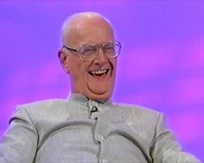
THIS IS YOUR LIFE - Arthur C Clarke, science fiction writer, was surprised by Michael Aspel at the Science Museum in London, having been led to believe he was there to film his television series, Mysterious World.
Arthur, who was born in Minehead, began writing about space travel for a school magazine and joined the British Interplanetary Society at a young age. He served with the RAF during the Second World War, was involved in the early-warning radar defence system, which contributed to the success of the Battle of Britain, and developed the idea of using satellites as ideal telecommunications relays.
After graduating in mathematics and physics at King's College London, he became a full-time writer, specialising in science and science fiction. He published over 80 books and many essays, and co-wrote the screenplay for the influential 1968 film 2001: A Space Odyssey.
"Oh no! Well, this is all a plot!"
programme details...
- Edition No: 903
- Subject No: 886
- Broadcast date: Wed 11 Jan 1995
- Broadcast time: 7.00-7.30pm
- Recorded: Thu 25 Aug 1994
- Venue: unknown
- Series: 35
- Edition: 11
- Code name: Year
on the guest list...
- Mary - sister
- Buzz Aldrin
- Lois Aldrin
- letter from Stanley Kubrick
- Michael - brother
- Fred - brother
- Patrick Moore
- Joan Temple
- Sir Edward Fennessy
- Dot Jones
- Hector Ekanayake
- Valerie Ekanayake
- Cherene Ekanayake
- Tamara Ekanayake
- Melinda Ekanayake
- Heather Couper
- Sean Lewis
- Kathy Keeton
- Alexei Leonov
- Svetlana Leonov
- Bobby Pleass Filmed tribute:
- Helen Sharman
production team...
- Researchers: Sally Millson, Caroline Blackadder
- Writer: Roy Bottomley
- Director: Brian Klein
- Associate Producer: John Graham
- Executive Producer: Peter Estall
- Producer: Malcolm Morris
- names above in bold indicate subjects of This Is Your Life

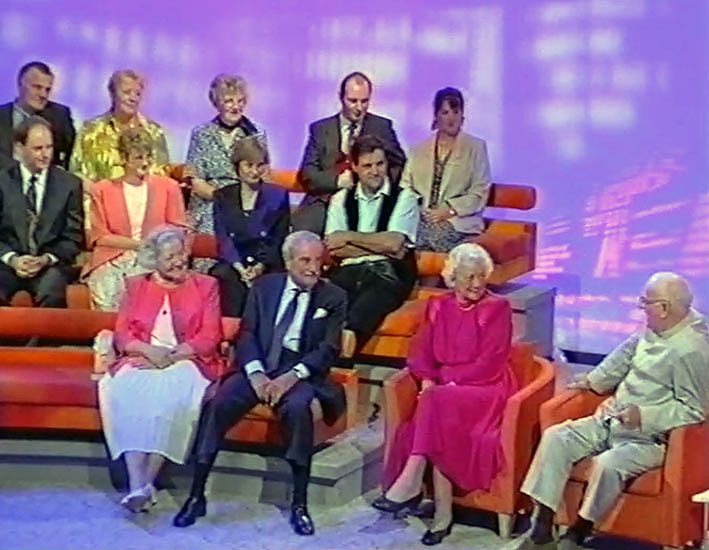
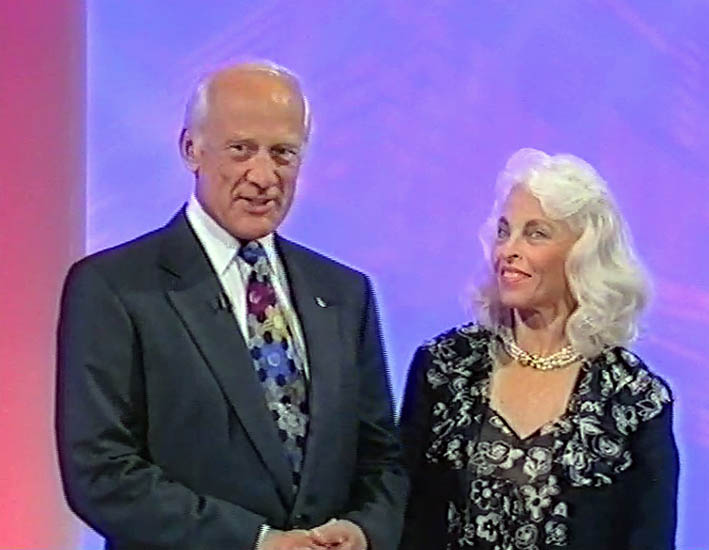
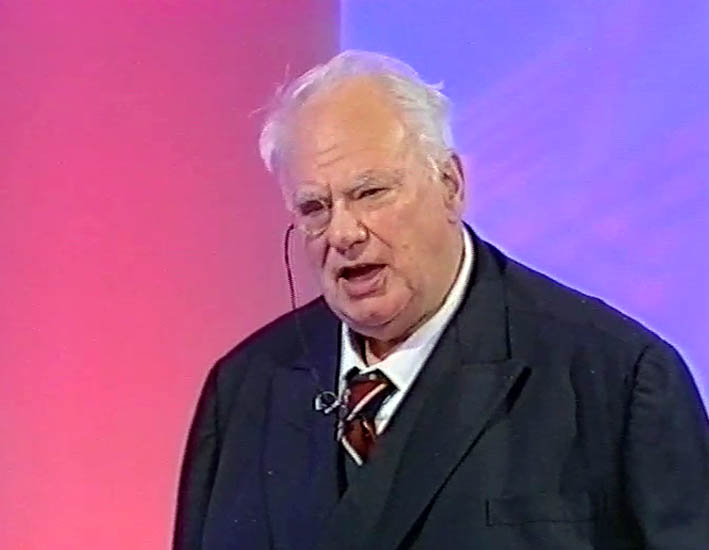
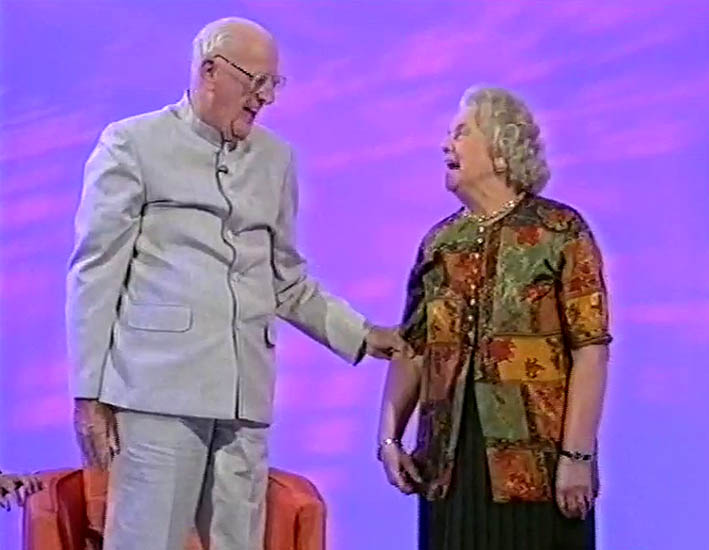
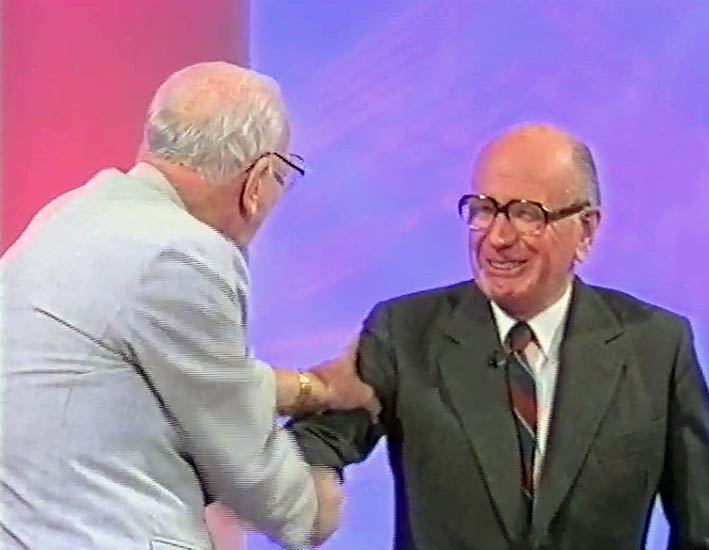


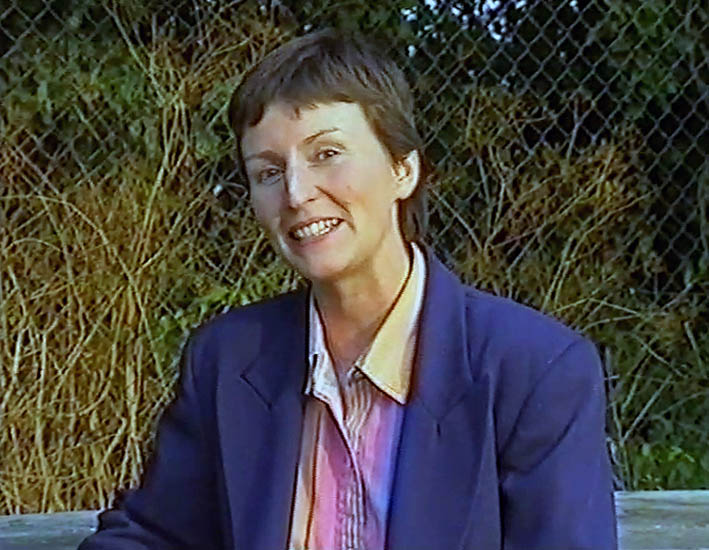
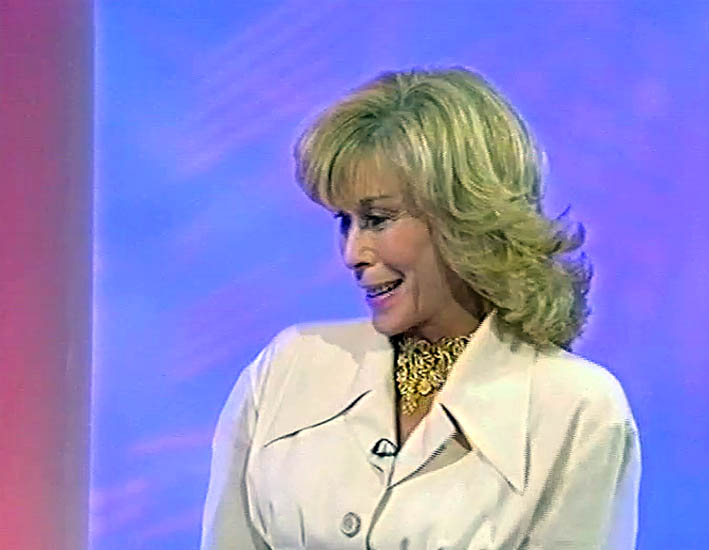

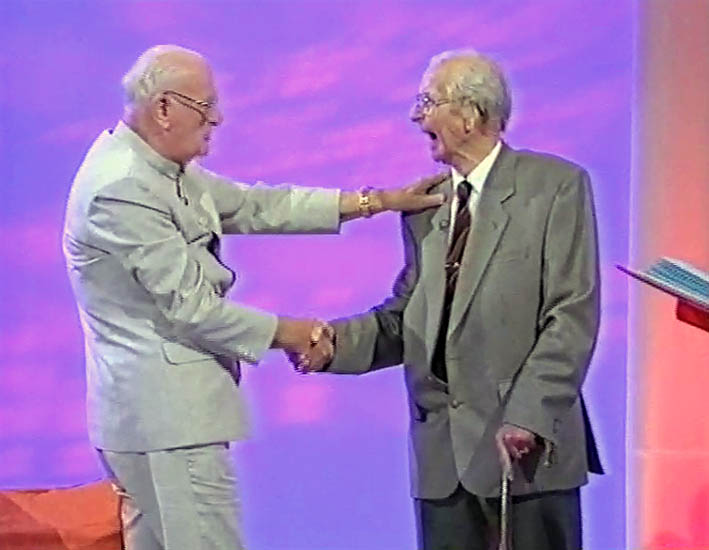
Screenshots of Arthur C Clarke This Is Your Life
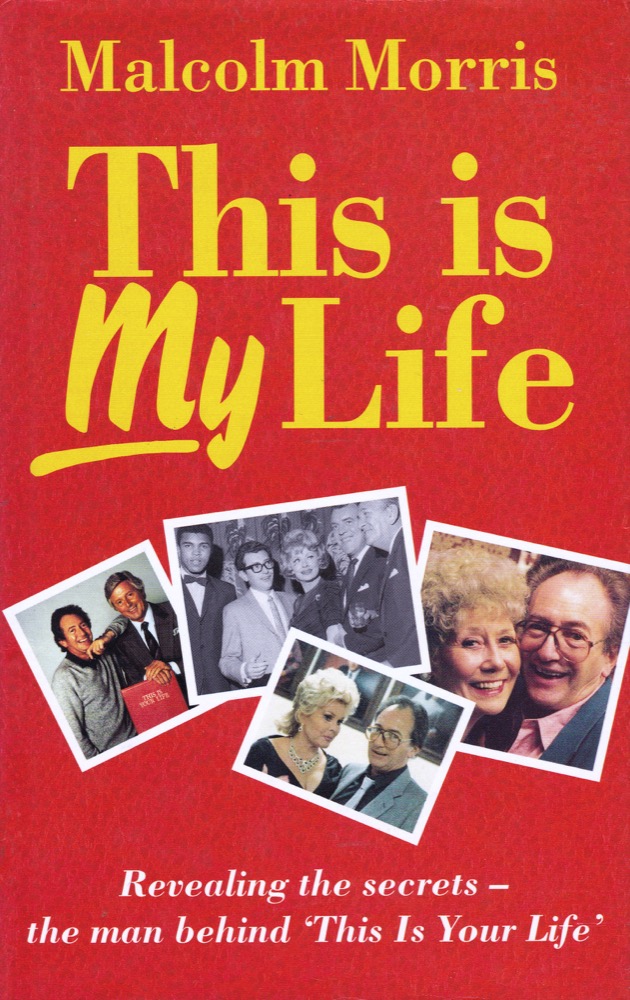
The next challenge was nearly ruined by myself and my idiot obsessions. The Science Museum in London seemed to me to be the perfect place to capture Arthur C Clarke, the wonderful author of 2001 and 2010 and many other books of fact and fiction. I love science fiction and was glued to all the Apollo NASA programmes, so when I got the chance to do the programme on Arthur C Clarke it was my opportunity to dream up the scheme of my lifetime.
Arthur had forecast the use of space satellites for intercontinental communications way back in the fifties, and he had close contact with NASA. One of his closest friends was Buzz Aldrin, the second man after Neil Armstrong to actually walk on the moon.
Buzz agreed to come over and I shook the hand of the man who walked on the moon. I was in heaven.
Arthur was due to arrive at the Science Museum at three o'clock in the afternoon and I had hidden all my cameras and Michael behind the rockets and satellites. As Arthur approached the life-sized mock-up of the moon module, Buzz Aldrin was to step out from underneath the module and be Arthur's first surprise. The module stood on a very convincing landscape – or rather moonscape – and I had received special permission from the Science Museum security for us to cross the barriers protecting this exhibit.
I gave Buzz Aldrin the memo I received from the Museum. It reads: 'This is to give special permission to Mr Buzz Aldrin to walk on the moon surface.'
It was 25 years late but I'm sure he appreciated it.
Just before three o'clock I checked all our final plans as I stood by the Apollo 11 module. I could see and touch the scars on its side from the re-entry back to Earth. This was the stuff that dreams are made of. I couldn't resist the urge to abuse my special museum pass and cross the barrier and climb inside, which I did. It was amazingly small with very little room to move around in. I ran my hands over the instruments that had made history, so it was an abrupt jolt back to earth as someone whispered urgently, 'Get out fast!... Arthur's early!'
The trouble was I couldn't get out fast because not having been trained by NASA I did not know the trick and I just fumbled around inside, unable to move backwards. It may have been just 'one small step for man' but it was a giant leap for Malcolm Morris! I was actually so late that the camera was already on when I ran quietly past Arthur C Clarke as he approached the module. If anyone watches that programme again I'm briefly visible behind Arthur as he met Buzz Aldrin.
Michael made his introductions and Arthur stepped back with surprise, but he proved to be a wonderful subject for a most unusual programme.
Series 35 subjects
Andrew Lloyd Webber | Leslie Crowther | Mike Reid | Martin Bell | Marti Caine | David Wallace | Danny Baker | Stephanie ColePeter Ustinov | Lesley Joseph | Arthur C Clarke | Barry Cryer | Gretchen Franklin | Edward Woodward | Ned Sherrin | Spike Milligan
Howard Keel | Raymond Gainer | June Whitfield | Debbie Reynolds | Bill Cotton | Jimmy Hill | George Baker | James Herbert
Michael Denison and Dulcie Gray | Ivor Broom | Kriss Akabusi | Helen Shapiro